photo-01 photo-01 photo-01 photo-01 photo-01 photo-01

Snapshots

Hell/Judgment

by lefever on August 23, 2011

lefeveralbimural

I sat in a church listening to a preacher speak on the doctrine of hell saying that too many people shy away from the discussion but he was going to lay it out for us… that to shy away from the doctrine of hell is to be embarrassed of Jesus.

This is an evangelical Bible study church.  I probably should not have wandered on such an important subject as this, but I wondered why the walls were blank… and imagined how I might paint a Judgment scene on the front wall.

Not an original idea.

The preacher also alluded to the Catholic Church being soft on the doctrine of hell, quoting Pope John Paul II in some speech (the quote was out of context so I can not comment to its use in the preacher’s sermon).

To claim that the subject is not approached and that the Catholics in particular are soft is to ignore a few places built in the past where the subject was obvious in the very architecture.

Entrance to many a church and a Cathedral required the passing under a Judgment scene depicting people being cast into the maw of a monstrous death, or boiling in pots stirred by demon antagonists. The Sistine Chapel back wall itself is a Judgment scene by Michelangelo – the Sistine Chapel where each successive Pope is elected.

I traveled to Albi France specifically to photograph St. Cecile for her Judgment Wall–a unique muraled wall that separates the alter table and the Host Chapel.

lefeveralbi_mg_8694

Tell me that the Doctrine of Hell not being presented in any major or permanent way at St. Cecile- in a way that lives long after words fade? Talk about a reminder (every time one enters for communion and mass).

How wonderful that I had this image to draw on as the pastor spoke, and I felt sorry that there was nothing so powerful on the wall before us other than beige behind a stage of musical instruments. At least he was laying out the message…

I doubt though that a painted vista of judgment would have stopped those folks looking around or preoccupied by other things since they heard this message before, but I know my eye would land continuously on this image as my ears took in the preacher’s words. And I also know that my mind would be slower to return to the images of daily life around me after viewing such a image as it would likely burn itself into my brain and imagination as had the image from St. Cecile in Albi.

Oddly that scene made its way to this church today, but I am the only one seeing it.


~JWL

Wounds

by lefever on August 16, 2011

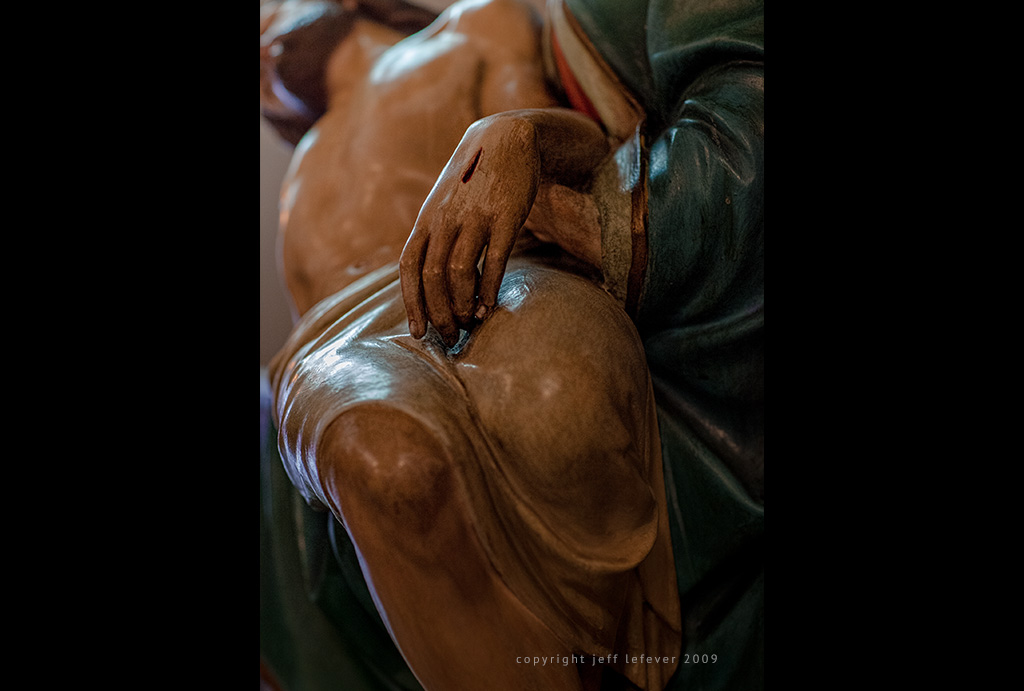
lefeverchicagowoundwxg5z0467 I am fascinated by the wounds. I am drawn to them. They resonate with me on many levels.

The pierced feet of Jesus, His hands, His side, the punctures to the crown of his head, the lacerations and bruises on His body, the swelling, the tears and rips, and the dried blood.

A quote from Beauty Will Save the World, (Gregory Wolfe) p.12 :

“…what ultimately drew me to the church [Catholicism] was another facet, one about which too little is spoken. It’s what the great Basque philosopher Miguel de Unamuno called “the tragic sense of life.” At the center of this sensibility is a profound awareness of the ambiguities and divisions within the human heart, along with a stress on the importance of suffering and contemplation. I came to understand why Catholics venerate the crucifix, not the empty cross…”

Many would disagree with me, claiming we praise a risen Lord and have taken Him off the cross, or stating that the crucifixion is not the saving grace but the resurrection; with out the resurrection there is no salvation. I have also heard to display Jesus crucified is to re-crucify Him over and over again.

Perhaps it is just I who is moved by the tragic. The resurrection has little meaning with out the crucifixion. Had Jesus just fallen asleep for our sin, and then rose from the dead, then the pain he endured for our sake is minimized. Seeing the wounds reminds me of the price that was paid on our behalf.  A statue or painting of the crucifix are not Jesus, nor a Pieta, but are reminders to me and to others – to all of us corporately – of the “tragic sense of life” and the “profound awareness of the ambiguities and divisions within the human heart,” the “importance of suffering and contemplation.”

What happens for me is my intellectual awareness from academic and practical study, drops from head knowledge to my heart through my imagination: I am united body and soul with the notion of culpability and love.

Nor is it a blame that is scornful or diminishing, rather it is a blame that conjoins me with the Love that pays my way. It is beyond words or description, and that is precisely the place where the Holy Spirit works.

It all works together.

I like the wounds we depict in the arts to remember the suffering, my suffering, and the suffering servant, who yes, is no longer on the cross.

And THAT is another subject of art for contemplation.

There have been times when critics have confused the tragic sense with mere fatalism. I suspect that is because Americans still suffer from the illusion that they can escape tragedy and remake themselves in the process. The truth as I come to see it is that the tragic sense of life is the ultimate antidote to religious arrogance and sentimentality as well as to the ideological triumphalisms of Right and Left

~Gregory Wolfe, Beauty Will Save The World

~ JWL
Pieta, Chicago.

8/2 In His Arms, Her Soul a Babe

by lefever on August 1, 2011

lefeverdormitionabby1

Down below the beautifully mosaicked Abbey of the Dormition of the Virgin Mary (Haggia Maria Sion Abbey) in Jerusalem on Mt. Zion, is a Marian crypt. It is claimed to be the spot where the Virgin Mary fell asleep for the last time.

There is a statue of Marian sleeping in peace, above her a mosaic dome of Christ and six epic Biblical ladies.

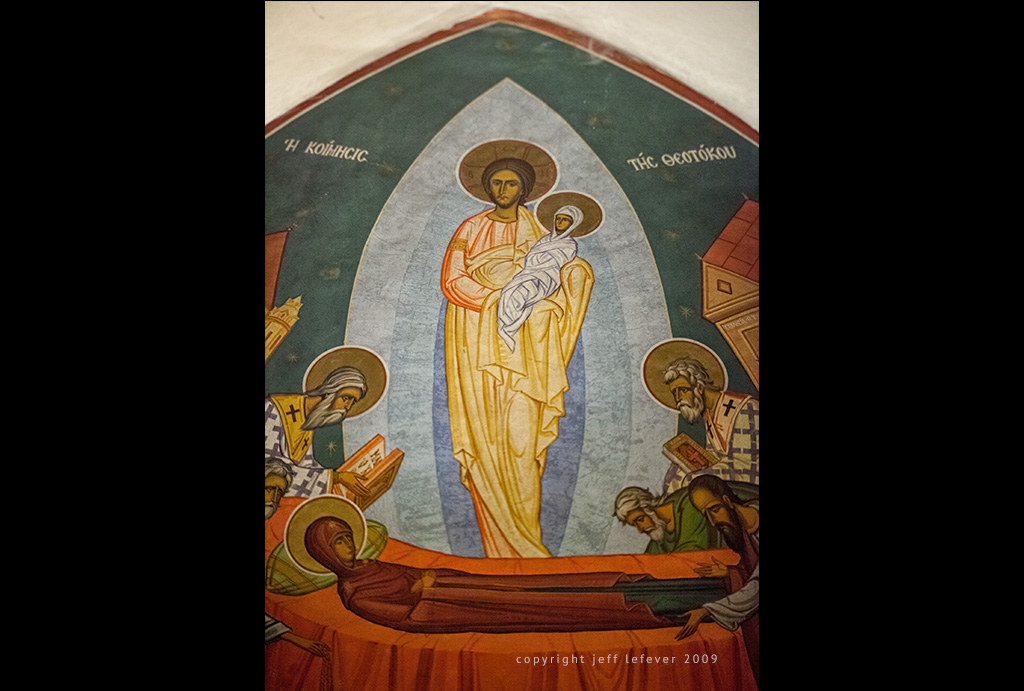
But there is one mural at one of the altars that stops me in my tracks. It depicts the Virgin’s Koimesis, or “falling asleep in death.” lefeverdormitionabby

Mary lies still being attended to.

Christ stands above her.

Just as Mary bore the infant Christ, she is now carried to heaven by Christ, who holds her soul, portrayed as an infant, in his arms.

The “Mother of God is now His daughter… or put another way, the Son of God’s Mother is His daughter”. I put that in quotes as something to absorb just below the consciousness of literalism – to consider the paradox. Just as Jesus is before Abram was born (John 8:58). Mary’s son is her heavenly father, and He is come to carry her home.

Twice now in Jerusalem I have been theologically rocked with LARGE mystical thoughts to contemplate: the mystery of God. Both times were bound around considerations of Mary’s relationship with God.

The first time was in the Armenian Cathedral, St. James. There I was left with the thought of what does one do with the rest of their life when they have birthed Mashiach? That is a big responsibility and it can not be like any ordinary responsibility for this is no ordinary child. God had consecrated Mary’s womb and lived there for nine months. Think about it.

The idea that God is the Father to Mariam’s impregnation of Himself incarnate, suggests He is the Father and the Son and now He is the creator of Mary’s soul, now swaddled in His arms and safeguarded to the Spiritual Heaven.

A shudder goes up my spine and I need to sit down.

This piece of art communicates a powerful idea of the immensity of God, His mystery, His wondrous ways, and the tenderness of His Grace. Considering God this way is overwhelming. Perhaps this is the proper perspective…

~ JWL

7/25 What a Master Brings.

by lefever on July 25, 2011

I watched these videos on the making of Christ the Light – both are telling. One tells us the function of a church to a community – so very impressed by the medical care extended to those without medical insurance. I am [continue reading]

The Sound of Worship

by lefever on May 9, 2011

I am at the Church of the Holy Sepulchre in Jerusalem facing the entrance that opens up to the Stone of Unction. I am standing in the small courtyard just outside that front entrance.

I hear singing, a chant of sorts.

I walk to a small door at the right of the courtyard. This is the entrance to the Coptic Church and it is the service of these Egyptian Christians that draws me to witness.

The Coptic Chapel of St. Michael the Archangel is filled with a most beautiful and religious sound; a cross between two sounds I am familiar with (only for a rough reference), the Muslim adhan and Gregorian chant. Not knowing the language I almost feel it is stream of consciousness. It may be.

I get caught up in the stream and close my eyes. empty_holysep

I open my eyes and see a man, a Coptic monk perhaps, outside the gated sanctuary.

His face is in an ecstasy as he chants along, holding on to the vertical bars of the fencing. He is in an area that seems to be his area of service, a plate for coins sits on a small table.

I do not want to disturb him in his engagement to the worship. His face is so blissful. The sound is enchanting. He is wearing hearing aides.

~JWL

The Coptic Chapel, Holy Sepulchre, Old City Jerusalem

The Dying To Live

by lefever on May 9, 2011

stmichaelolomouc

St. Michael’s in Olomouc, Czech Republic, is an ornate marble church in the Baroque style, very richly done. The marble is dark salmon and fleshy, the church is lavishly painted and the ceiling exquisite – overhead, the theology.

There is a side chapel flanking a square courtyard, the kind you would see in a monastery: walking halls that circumnavigate an open square inner garden.

Inside the halls are beautiful paintings serving as Stations of the Cross.

It is quiet and I am walking around alone, unattended. Only a nun is present in prayer, and she sits up front of the nave facing the alter.

I am in the hall looking at a painting of Christ being offered drink; He drips blood from his scourging. There is a door behind me on the opposite wall of the walkway.

My curiosity pulls me toward it.

I check it to see if it is locked­–it is not.

Looing to my left and to my right… I pause… then open the door and swiftly slip through the door to a landing atop descending stairs.

I cautiously descend into darkness, into a small cave-like room. No, it is a cave. Lights are on but it is dim.

It is not big and I am crouching at the one end where there appears to be a pool.

Yes, it is a pool with a stone cross. An arched opening to my left reveals a couple chairs, a small statue of Mary, a framed poster print of the risen Christ with sacred heart radiating the light of truth and the light of His love to us all.

It is a small space, thrifty and effective. For me, being underground in tight space alarms my sensitivities.

I have seen many a Baptismal pool, but this one acts symbolically  (and effectively) in a way the others do not.

I realize I am in the belly of the earth. I am claustrophobic and even my interest in documenting this unique place digitally can not quiet my heart from pounding or my breath from quickening.

To be baptized here is to surely encounter one’s symbolic death. I am actually getting the creeps.

I imagine what it must be like to be baptized here. stmichaelolomoucstairs

Descending into darkness, one’s focus is sharpened to the commitment at hand. This is a very visceral pit, not unlike a grave chamber.

What is most interesting to me is the ascent from below into the light above.

When one dies to their old life in this pit, they ascend to the light of day –  one arises from a life not fully realized or fulfilled, a life in darkness,  dimly lit artificially, to their new life in the True Light.

As the newly baptized ascends the steps the first images one encounters at the top of the steps are of Jesus in the paintings walking toward His crucifixion.

That is powerful. stmichaelolomoucchrist

And when they step into the awaiting church, the hosts of Heaven celebrate. The newborn to the Faith stands inside a space decorated with meaning that now comes alive with the splendor of heaven.

——-

I get the sense that religion is taken very seriously here.

~JWL

St. Michael’s, Olomouc, Czech Republic

5/2 Paper Prayers and Song: HaKotel

by lefever on May 2, 2011

Every crevice and crack within reach of a human hand, in and between the large Jerusalem Stones* of HaKotel are stuffed with prayers: pencil, ink, marker, crayon…a painting… on white and colored papers of all kinds folded so tightly and squeezed into any available space with the hope that here, more than anywhere, God will take note, and prayer will be answered. Pilgrimages are made to HaKotel to pray. hakotelprayers-lefever

The sages state that anyone who prays in the Temple in Jerusalem, prays before the throne of glory because the gate of heaven is situated there and it is open to hear prayer. Though the Temple is destroyed, though Christians would argue that Jesus eliminated the Holy of Holies when becoming the High Priest– this wall remains and is said to have always been protected by God.

I have brought my prayers. I have brought the prayers on paper of family and of friends, and sponsors of this trip.

I must search for a space and then compact my delivered prayers even smaller to wedge them individually into different areas wherever I might find even the smallest cleft. Prayer notes fill the cracks like mortar.

These prayers get removed and buried at intervals. I am between intervals.

These paper prayers are everywhere in the Wall. Prayers for the dead and the dying. Prayers for blessing. Prayers for help and guidance, hope and need. Prayers of Love to Abba Father. Prayers of gratitude–and the Talmud teaches that all prayers ascend to heaven through Jerusalem. It is thought that writing a prayer on a piece of paper and placing it into HaKotel is like having a continual prayer linked to the prime source.

This Western Wall, the remnant of the Temple, is proof to the Jews of God’s promise to be with them and to never forsake them His Chosen People. Divine Presence rests on the Western Wall more than other places.

God’s presence is felt here.

The intent of the Jew is felt here.  Facing the wall, prayers are read from books, prayers are recited and sung in minions.

Some people are here for hours. Joy and thanksgiving, tears and anguish permeate the air–and pleas for a restored Israel and the rebuilding of the Temple.

Here the art is in the performance of worship: written word, recitals and song, and the costumes of the religious all bring deep meaning to a space where God is met. It is history. It is legacy. It is intentional and it is now.

God and humanity imbue HaKotel with deep meaning– a sacred site.

~JWL

* Jerusalem Stone is a general term, to be exact: meleke limestone (meleke- Arabic“royal” or “kingly”).

A song: http://www.hebrewsongs.com/song-hakotel.htm

4/25 Jewish Roots Overhead

by lefever on April 25, 2011

Do they know that upon their ceiling is the Magen David: The Shield of David (representing God as David’s true shield so poetically sung in the Psalms)? Or is this just the design of six arcs in a dome – a practical architectural design? Or is it both? wstjamesceiling-lefever

Occasionally I will see somewhere in a church, a Star of David in a mural or even the décor such as above to the right of St. Michael’s Alter in Chicago or on the face of the font at Grace-St. Lukes in Memphis…a small tie to Christianity’s past, the God of Israel, and hence Jacob, Isaac, and Abraham – the promises of God to those he had covenant and the continuation into the New Covenant in Jesus, the divinely anointed King through His sacrificial death and resurrection.

Here, this is no small nod to the past, or a mere wink as in other churches, if it is intentionally designed, this most recognized symbol of the Jewish people, this design of unity, this connection to the past from whence Christianity was born hoovers as a covering over the Armenean Orthodox Cathedral of St. James like a shield representing the covering of God – with the symbol of Israel, the Magen David–a title of the God of Israel.

How much more powerful to be here in the Old City of Jerusalem – this land upon which the stage of history is set: this place where the Jews are the Chosen of God from whom Yeshua was born through Miriam.

Since I have been in this Old City of Jerusalem, this thought has been growing in me: this question of separation – why is, and why was the Christian tree separated from her Jewish roots? I had never sensed the separation before, but now I am feeling the completeness, the fullness of the lineage, and the severance from the roots makes the tree of Christianity feel dead, like the wood of the cross.

St. James, a Jew.

I am standing under the dome in the Armenian Orthodox Cathedral in Jerusalem wondering if they know that the “Shield of David” covers them.

~JWL

4/18 Dark/Light-Pain/Joy

by lefever on April 18, 2011

Outside, it is snowing.

Inside, St Mary’s is dark, or shall I say, dimly lit. But then what is light with out darkness upon which to show it?

My eyes adjust.

I see many homeless in the pews. Some are sleeping upright. They are in the safety of St. Mary’s church.

I make my way to one of the side chapels and sit. Above me is a sculpture representing the crucified Christ. The sculpture is carved from wood. stmaryscrucifix-lefever

I feel as though He looks down upon me. This is not something I think about on any regular basis. But here, now, with this woodcarving, I imagine the Christ and he is looking down upon me. And because this sculpture is not Him, I can look back and consider His gaze.

In between mass and worship, it is the art in this church, as in others, that tells me this is a church, and expresses to me The Story. In this quiet time the art captures my imagination from where it was wandering just minutes before outside in the snow and the hustle of life.

Not just the crucified Yeshua holds my mind, weighing heavily on my conscience with all we have attached to this image in study and understanding, but also the hope of the resurrection and all that implies and promises, for on the other side of the crucifixion carving is a wall painting of Christ in Majesty. Christ encircled by His heavenly hosts, stmaryscrucifixback-lefever  sits on the throne marked Alpha and Omega, a reminder to us of Love and Grace and Divine Justice, Divine Mercy.

It is here in this little chapel with its theological décor that I am given a peak to consider what resurrection life might mean and from here, how this relates to my/our perception of daily reality in the city, in the snow.

On one side is the pain of the sacrifice to consider in all its profound depth and meaning; symbolically, historically, continually “once and for all.” On the other side is the joy of the promise…

Art does this. It captures our imagination in a way that is set and unchanging for us to consider. Slowing us down into a moment so that we can “hear” the Spirit “speak”–our minds can reflect, our souls can expand.

Just sitting in these visuals has an effect, as sitting in the visuals of commercial media has its effect. This is church as alchemy, converting earthly lead to heavenly gold.

Here I can rest and re-member myself  as being made in His image, to be perfected in His likeness, to more accurately bear the image of God and to consider the things unseen but no less transformative.

St. Mary The Virgin, Times Square, NYC.

~JWL

4/11 Holy, Holy, Holy

by lefever on April 11, 2011

angelssevennations-lefever

Like the mosaic angels high above the alter, the man in front of me raises his hands in praise.

An echo occurs: his praise echoes the angels’ praise echoes the man’s.

It is poetic. There is reverence both represented and actual.

Holy is here.

Church of the Seven Nations, Jerusalem 2009.

~JWL